
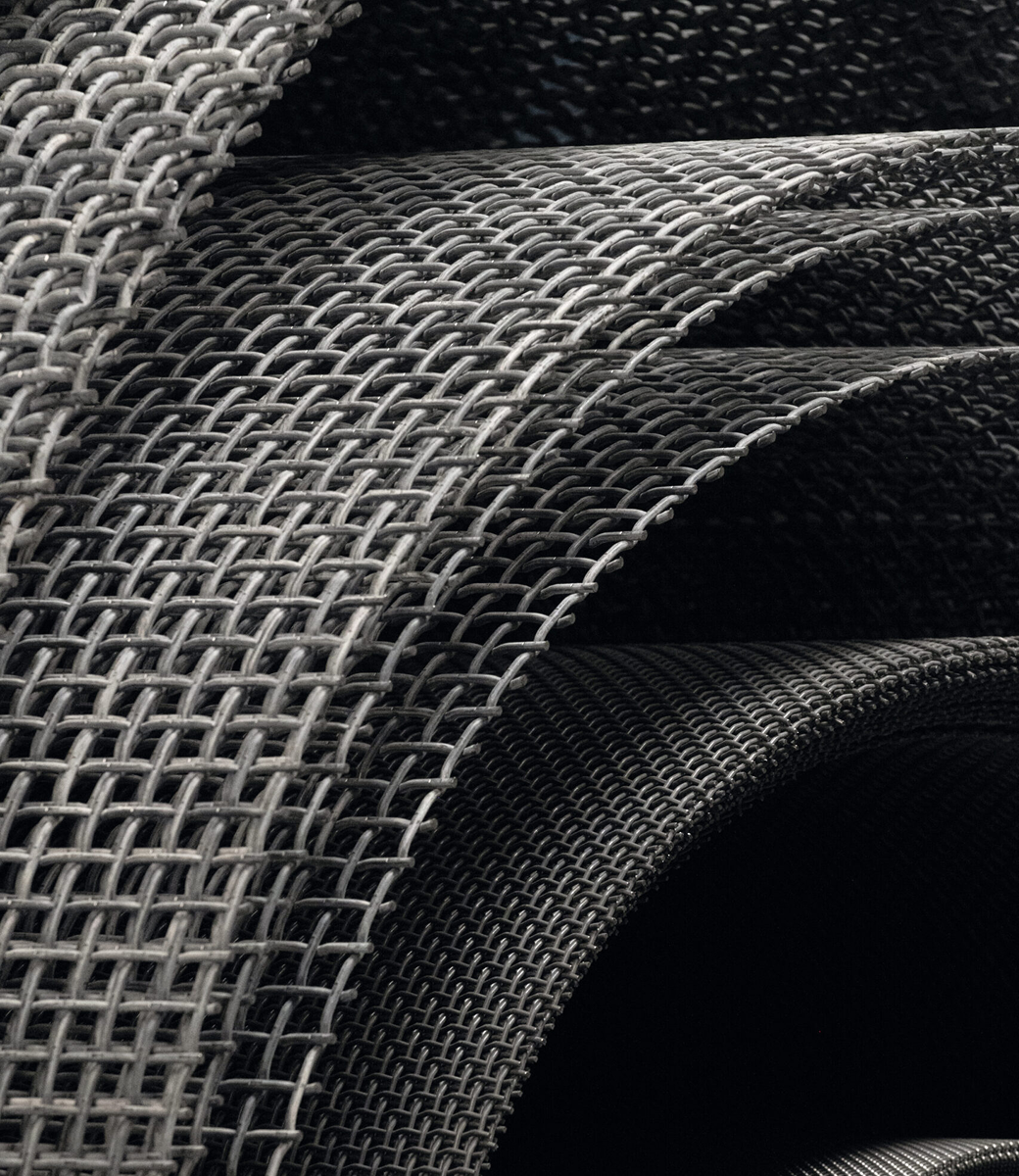
Classic canvases
These screens are designed to meet the screening requirements of abrasive materials, such as those encountered in the extractive industries.
The warp and weft wires are preformed here before weaving. They are therefore corrugated or notched to enable the weaving of steel wires up to 20 mm in diameter.
The steel used is mainly high-strength steel, with a carbon content of at least 0.5% and a tensile strength of between 900 N/mm² and 2000 N/mm², depending on the cross-section of the wire used. Stainless steels are essentially nickel-chromium base alloys. They may contain varying amounts of molybdenum depending on the environment in which they are used.
In order to be able to respond as quickly as possible to emergency situations, GIRON has set up a permanent stock of 12,000 square metres of steel mesh, representing around 200 mesh/wire references, in the most common square meshes.
Square meshes

Wire: 0.5 mm to 3 mm
Due to the relatively open closure angle at the wave crests, this type of preforming is particularly sensitive to shocks, especially when the mesh-to-wire ratio is high. This is also why this type of mesh is generally limited to the finest cuts.
Wire: 4 mm – 20 mm
The GIRON preforming ensures better anchoring of the wires in their original positions, allowing Plangirco meshes to withstand significant mechanical stresses without affecting the mesh structure. This results in an unmatched longevity compared to competing products.
This type of mesh is particularly suited for larger cuts, especially in its PLANDUR version (Wire ≥10 mm), which, by using a special steel, can withstand even greater impacts without the risk of rupture.
Wire: 4 mm – 8 mm
By combining closed-angle stamping with wire embossing at each crossing point, the GIRON preforming ensures maximum material contact with the screened products and eliminates any risk of relative movement until complete wear occurs.
The Plangirco flat-surface mesh naturally excels in all medium meshes where cutting precision and abrasion resistance are critical. Plandur Flat Surface versions can also be offered if the screening applications are compatible.
Wire: 0.5 mm to 3 mm
Due to the relatively open closure angle at the wave crests, this type of preforming is particularly sensitive to shocks, especially when the mesh-to-wire ratio is high. This is also why this type of mesh is generally limited to the finest cuts.
Wire: 4 mm – 20 mm
The GIRON preforming ensures better anchoring of the wires in their original positions, allowing Plangirco meshes to withstand significant mechanical stresses without affecting the mesh structure. This results in an unmatched longevity compared to competing products.
This type of mesh is particularly suited for larger cuts, especially in its PLANDUR version (Wire ≥10 mm), which, by using a special steel, can withstand even greater impacts without the risk of rupture.
Wire: 4 mm – 8 mm
By combining closed-angle stamping with wire embossing at each crossing point, the GIRON preforming ensures maximum material contact with the screened products and eliminates any risk of relative movement until complete wear occurs.
The Plangirco flat-surface mesh naturally excels in all medium meshes where cutting precision and abrasion resistance are critical. Plandur Flat Surface versions can also be offered if the screening applications are compatible.
Rectangular meshes
Wire: 0.5 mm – 3 mm
A flat surface version is also available.
The Lonplandur version uses a steel that is slightly less efficient in pure abrasion resistance but offers better shock resistance.
Wire: 4 mm – 16 mm
By combining a closed-angle stamping and the embossing of wires at each crossing point, the GIRON preforming ensures maximum material contact with the screened products and eliminates any risk of relative movement until complete wear.
The Plangirco flat surface mesh naturally excels in medium mesh sizes where cutting precision and abrasion resistance are crucial.
Plandur Flat Surface versions can also be offered if the screening applications are compatible.
Wire: 1 mm – 2.5 mm
By combining a closed-angle stamping and the embossing of wires at each crossing point, the GIRON preforming ensures maximum material contact with the screened products and eliminates any risk of relative movement until complete wear.
The Plangirco flat surface mesh naturally excels in medium mesh sizes where cutting precision and abrasion resistance are key factors.
Plandur Flat Surface versions can also be offered if the screening applications are compatible.
Wire: 0.5 mm – 2.5 mm
Their preforming ensures a perfectly flat working surface with parallel wires, providing both excellent cutting precision and strong mechanical resistance.
Additionally, the flat surface has the advantage of generating fewer fines when processing soft products.
Wire: 0.5 mm – 3 mm
A flat surface version is also available.
The Lonplandur version uses a steel that is slightly less efficient in pure abrasion resistance but offers better shock resistance.
Wire: 4 mm – 16 mm
By combining a closed-angle stamping and the embossing of wires at each crossing point, the GIRON preforming ensures maximum material contact with the screened products and eliminates any risk of relative movement until complete wear.
The Plangirco flat surface mesh naturally excels in medium mesh sizes where cutting precision and abrasion resistance are crucial.
Plandur Flat Surface versions can also be offered if the screening applications are compatible.
Wire: 1 mm – 2.5 mm
By combining a closed-angle stamping and the embossing of wires at each crossing point, the GIRON preforming ensures maximum material contact with the screened products and eliminates any risk of relative movement until complete wear.
The Plangirco flat surface mesh naturally excels in medium mesh sizes where cutting precision and abrasion resistance are key factors.
Plandur Flat Surface versions can also be offered if the screening applications are compatible.
Wire: 0.5 mm – 2.5 mm
Their preforming ensures a perfectly flat working surface with parallel wires, providing both excellent cutting precision and strong mechanical resistance.
Additionally, the flat surface has the advantage of generating fewer fines when processing soft products.